IncomeRPG › FAQ
IncomeRPG — questions, answered
Everything people ask before they connect a brokerage: what it costs, what it can and cannot touch, what it tracks, and how the game layer works. 24 answers, no fluff.
Open IncomeRPG →No answer matches that. Try a shorter word — or ask us directly.
Pricing & plans
What it costs, what is free, and what happens if you stop.
What does it cost?
$59.99 a year — or $34.99 a year if you join during the beta as a Founder, a price that never rises for as long as your subscription stays active. One price, everything included — there are no tiers, add-ons or upsells inside the app.
Free: this Welcome page and the full 20-part walkthrough. Read everything, understand the whole system, decide in your own time.
Premium unlocks the rest of the app — brokerage sync, all your tracking pages, contribution testing, milestones, and the game itself.
There is no free trial. Cancel any time from your account — it is a normal Stripe subscription, not a contract.
Can I see it before I subscribe?
Not as a trial, no — but you do not have to buy blind either.
This whole page is free, and so is the walkthrough — twenty parts covering how income funds work, what covered calls cost you, leverage, total return and the Feeder Strategy. It is the entire idea the app is built on, explained before you pay for anything.
There is also a video library showing the app in use — currently on Instagram — so you can watch the real thing running on a real portfolio rather than take our word for it.
Subscribing is what connects your brokerage and turns those explanations into your own numbers.
What happens if I cancel?
You keep access until the end of the period you have already paid for, then the app returns to the free view.
Nothing is done to your money. Your investments were never held here — they stayed at your brokerage the whole time, and cancelling does not touch them.
You can disconnect a brokerage yourself at any point, with or without cancelling. That revokes the read-only access immediately.
It is a normal Stripe subscription — cancel from your account, no email required, no retention maze.
Connecting your brokerage
Which brokers work, how many accounts, and what it looks like on a phone.
Which brokerages can I connect?
Canadian and US brokerages, including ones like Wealthsimple, Questrade, TD Direct Investing, Robinhood and Moomoo.
The list is SnapTrade's, not ours, and it changes as they add institutions — so the connect screen always shows what is actually available the moment you open it. That is the authoritative list, not this page.
If yours is not on the list, IncomeRPG cannot read your holdings yet — the walkthrough is still free to read, and the list grows.
Can you connect more than one brokerage?
Yes. You can link several supported brokerages to one IncomeRPG account, so everything you own is tracked in one place instead of split across platforms.
Each connection gets its own name and colour, and you can view them one at a time or combined.
Multiple connections are in beta — please report anything that looks wrong.
Can you connect multiple accounts from the same brokerage?
Usually yes. One connection is one brokerage login, and that login brings in every account it already covers — so a TFSA and an RRSP under the same login arrive together.
If you need accounts that sit under a different login, add a second connection. Each one is stored and shown separately, so you can always see which holdings came from where.
Which accounts are available is decided by your brokerage, not by IncomeRPG.
Does it work on my phone?
Yes. It is built for phones first and you can install it to your home screen — it then opens like an app, full screen, with no browser bar.
Your kingdom is saved to your account, so the same portfolio, progress and Castellan follow you between your phone, tablet and desktop.
Safety & your data
Read-only access, where your data lives, and what we never touch.
Does IncomeRPG hold or move my money?
No. Your money stays at your brokerage, in your name. IncomeRPG connects with read-only access and cannot buy, sell, withdraw, or move anything.
You never send IncomeRPG money to invest, and you never invest through it. You invest through your own brokerage exactly as you do now.
The connection itself is handled by SnapTrade on your brokerage's own login page — your credentials never pass through this app.Who connects the accountA regulated third-party service that brokerages let you authorise. You sign in on your brokerage’s own page, and SnapTrade hands IncomeRPG a read-only token — never your password. It is the same pattern your bank uses when you link an account elsewhere.
What happens to my data?
We store your email, your subscription status, and your saved kingdom so it follows you between devices. That is it.
We never see or store your brokerage password. The connection is held as a token issued by SnapTrade, which is what lets us read your positions — and nothing else.
Your data is not sold, and it is not shared with advertisers. Disconnecting a brokerage removes its access, and deleting your account removes the save with it.
Your numbers
What gets tracked, how fresh it is, and what to do if something looks off.
How current are the numbers?
Prices refresh live while you use the app, cached for about ten minutes so a page you re-open is not re-fetching the same quote.
Holdings come from your brokerage through SnapTrade, which keeps its own copy and refreshes it on its own schedule — often about once a day. So a fund you bought this morning may not appear immediately.
Pressing Re-sync asks your brokerage for fresh data first, then reads it. That is a real request to your institution, so it only happens when you press the button — never on a timer.
If a brand-new position still does not show, give it a minute and press again. The brokerage end is not always instant.
What if a number looks wrong?
Tell us. For a tracker there is no such thing as a small numbers bug, and they are the ones that get fixed first.
Most of the time the cause is timing rather than maths — your brokerage had not published the trade yet. Press Re-sync, which asks your institution for fresh data instead of re-reading a stored copy.
The app is deliberately built to refuse rather than guess: a holding with no price or distribution on record shows "no data" instead of a confident zero, an unconvertible currency stops a total rather than silently mixing dollars, and a fund's declared payout is checked against the cash your broker actually paid you.
Unknown is never displayed as zero. If a figure is on screen, something real is behind it.
What does IncomeRPG actually track?
Everything lives under one 📊 Track menu. Nine views, each answering a different question:
- 📈 Portfolio Stats — what it is all worth right now, your total return, and a ring showing which holding is what share of it.What it is all worthLive value against what you actually put in, all-time and windowed total return, and a 3D ring that slices the portfolio by holding. Deposits are separated from gains, so money you ADDED is never reported as money you MADE.
- 💰 Dividend Stats — what each holding actually pays you, sliced by income instead of by value. Most apps only slice by value.What it pays youThe same ring, sliced by INCOME instead of value — so a fund that is 12% of your money but 4% of your cash flow is obvious at a glance. Plus lifetime collected, yield on cost, payment cadence and income growth.
- 📊 Fund Compare — up to ten funds at once, in dollars, with what they actually pay you and the rough patches shown.Face off up to 10 funds at oncePut a fund against as many as nine others — or against ones you already hold — and see what $10,000 would have become, split into price change and distributions. Three readings on the same data: price alone, price plus dividends taken as cash, and dividends reinvested. Payment cadence is counted from real payment dates, so a fund paying 24 times a year is never labelled “monthly”, and the worst drop over the window sits beside the return rather than out of sight.
- 🏆 Milestones — your journey with real dates, rebuilt from your own brokerage history rather than the day you signed up.Your journey, datedThree tracks — portfolio value, monthly income, and holdings collected — each tier stamped with the date you actually crossed it, reconstructed from your brokerage history rather than the day you installed the app.
- 🔥 F.I.R.E. Contributions — your latest deployment as a before ⟶ after, showing what that money actually bought you in income.Financial Independence, Retire EarlyTracking how much of your monthly cost of living your portfolio income already covers. Cover one bill, then the next — the app dates each milestone from your real history rather than a projection.Before and afterYour latest deployment as a side-by-side: what the portfolio looked like before the money went in, what it looks like now, and exactly which holdings received it. It separates your own cash from dividends that were reinvested.
- 🔬 Holdings Lab — every holding's real numbers in one table, under your own nicknames.Every number in one tableEach holding with its real shares, book cost, live value, yield and distribution — under your own nicknames rather than tickers, if you prefer.
- 🧪 Test Contributions — split an amount across holdings and see what each would add per month, before you spend it.Before you spend itSplit an amount across several holdings and price each line on its own live numbers. It refuses to guess: no price or no distribution on record means it says so rather than projecting a zero.
- 📒 Budget Tracker — money in versus money out, so portfolio income can be measured against what your life actually costs.The other half of F.I.R.E.Money in versus money out. Portfolio income only means something measured against what your life actually costs — this is where that comparison lives.
- 🌴 Retirement Calculator — what you would need to retire, and whether what you hold now could actually get you there.Can your portfolio fund your life?Four separate answers, never blended into one: whether the distributions cover your life today, how long the money lasts if you stop adding and stop reinvesting, the portfolio value you would need to retire and still reinvest part of the cash, and the value you would need if every distribution is yours to spend. It always shows cash coverage and after-inflation sustainability side by side, because a portfolio can pay every bill and still be shrinking underneath.
All of it is built from what your brokerage reports. Nothing is typed twice, and nothing is estimated when the real figure is available.
Is this only for income investing?
It is built around income investing, and that is what it does best — cadence, distributions, yield on cost, F.I.R.E. progress.
But it reads everything your brokerage reports. Growth holdings appear, get valued, and count toward your total return; they simply contribute little or nothing to the income side. The Feeder Strategy exists precisely because most people hold both.Price change + distributionsThe full result of an investment: what the price did AND the cash it paid you, added together. A falling price with large distributions can still be a positive total return — and a rising price with none can beat a high yield.
A portfolio with no income funds at all will still track correctly — it will just have a very quiet income figure.
The strategy
Income classes, the Feeder Strategy, and the Fat King.
What are the three income classes?
IncomeRPG groups income ETFs into three classes by payout level and risk: High Yield, Mid Yield and Low Yield.
In the game those appear as Horsemen, Rangers and Shieldmen.
These are classifications, not ratings. Higher yield is not automatically better.
What is the Feeder Strategy?
You choose a percentage of the cash your income ETFs pay out, and that share is redirected into one growth-focused ETF instead of being spent or reinvested into the income side.
It gives one portfolio two jobs: income now, growth later. You set the percentage, and you can change it any time.
This is IncomeRPG's own framework, not a standard industry term. It does not create extra return on its own — it only decides where part of your distributions go.
What is the Fat King?
The Fat King is your crowned growth ETF — the single holding that receives the percentage of payouts you choose to feed into growth.
You pick who wears the crown from what you already own, and you can re-crown a different holding whenever you like.
What crowning actually does: the feed converts income into something else. Crown a holding that grows more than it pays and every feed compounds into growth. Crown a high-yield holding and the feed largely circles back into the same income pool. Both are valid — they just do different jobs. Which one fits your plan is your call.
The game layer
Hero Cards, species and evolutions — and the line they never cross.
What are Hero Cards and Evolutions?
Hero Cards turn each holding into a collectible card with its own art, class and level — so your portfolio reads as characters rather than a row of tickers.
Evolutions are how those characters advance. As the amount you have invested in a holding crosses each
tier,
its card evolves into a stronger form, and the app shows exactly how much further the next one is.Evolution ladder — invested per holding Common · Baby$0 – $10k
 Uncommon · Novice$10k – $25k
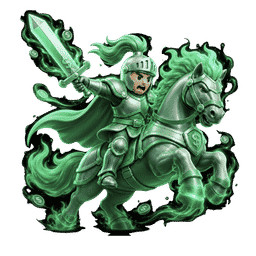 Rare · Vanguard$25k – $50k
 Epic · Peak$50k – $100k
 Legendary · Immortal$100k+Shown as the Horsemen line — Rangers and Shieldmen evolve on the same thresholds with their own art. Your crowned holding climbs its own ladder: Baby Prince → Prince ($25k) → King ($75k) → Emperor ($150k) → Kingdom God ($350k).
Cosmetic only. Nothing in the game layer changes your real portfolio or the numbers it reports.
How are species and evolutions decided?
15 species. 5 evolutions each. 75 in all. Which species a fund gets is fixed by its ticker — the same fund is the same creature for every player, forever. Its evolution stage is set by how much you have invested in it. These are classes, not ratings: higher yield is not automatically better.
On the Welcome page you can walk all five species in each class with the ‹ › arrows or a swipe, and EVO 1–5 is the same creature at five stages of growth.
Straight answers
The awkward questions, answered plainly.
Isn't gamifying investing a bad idea?
It is, when the game pushes you to trade. That is the version people rightly dislike — confetti for buying, streaks for logging in, nudges dressed as fun.
This one cannot do any of that. IncomeRPG cannot place a trade at all — the connection is read-only. There are no timers, no streaks to protect, and nothing that rewards you for buying or selling today rather than in a year.
Progress comes from one thing: what you actually own. You cannot buy crowns, levels or cards with real money — the only thing money buys is the subscription itself.
And the rewards are cosmetic. A castle, a card, a title. None of it touches your real portfolio or changes a single number the app reports.
Is this a real financial tracker, or a game with numbers?
A tracker first. It is built for people chasing financial independence, and the tracking is where nearly all the work has gone.
The 📊 Track pages are the proof: total return that separates deposits from gains, income sliced by what each holding actually pays, milestones dated from your real brokerage history, contribution testing that refuses to guess when it has no data, and a budget view so income can be measured against what your life costs.
None of that is decoration. Get any of it wrong and the app is worthless, which is why the numbers are held to a stricter standard than the game is.
The game comes second — it exists to make a decade of consistent investing something you want to come back to. It changes nothing about your money, and if you never opened it the tracker would still stand on its own.
A financial tracker that happens to be fun. Not a game that happens to hold your numbers.
Is there anything else like this?
There are good dividend trackers, and there are good portfolio dashboards. They mostly show you the same thing in the same shape: a table.
What is different here is that the portfolio is the game. Your holdings are the characters, what you have invested is what levels them, and the distributions they pay are the resource the whole world runs on. There is no separate game economy layered on top — remove your real portfolio and there is nothing left to play.
Whether that appeals is a matter of taste. It is built for people who found the spreadsheet accurate and easy to ignore.
Why not just use a spreadsheet?
If your spreadsheet is working, keep it. Plenty of good investors never need anything else.
What this does that a sheet does not: it pulls your real positions in so nothing is typed twice or left stale, it prices a contribution before you make it, it dates your milestones from your actual history, and it gives you a reason to open it on a month when nothing much happened.
The maths is not the hard part of long-term investing. Staying interested for a decade is.
It says BETA — should I be worried?
The badge is honest, and it means one thing: the app is still changing quickly. Features get added, screens get rebuilt, and the What's New notes move often. If you want something frozen and finished, this is not that yet.
What beta does not mean here is risk to your money. There is nothing to unwind — your investments sit at your own brokerage, in your name, and IncomeRPG only ever reads them. If it vanished overnight you would lose a tracker, not a dollar.
The money side is also where the care goes. Figures are cross-checked against what your brokerage actually paid, anything the app cannot verify is refused rather than estimated, and the calculations carry a test suite that has to pass before any release ships.
Priced accordingly, cancellable any time, and you can read this entire walkthrough before spending anything.
Can I watch it working before I buy?
Yes. There is a video library showing the app in use, running on a real portfolio rather than a mock-up — you can watch it on Instagram →
Reading that a portfolio becomes a kingdom is one thing. Watching a distribution land, a holding evolve a tier, and a milestone date itself is what actually makes the idea click.
It is moving onto this page shortly. The 20-part walkthrough here is free in the meantime, and covers the strategy the whole app is built around.