Why young people don't start investing
Young people usually do not skip investing because they cannot afford it. They skip it because nothing about it is legible at twenty: the payoff is decades away, the first deposit changes nothing visible, losing money feels worse than gaining it feels good, and the whole activity is presented as a spreadsheet. The fix is almost never more information — it is making the first year of investing produce something a person can actually see.
- The most common regret among people who invest is not starting sooner.
- The barriers at twenty are mostly psychological: no visible feedback, loss aversion, and a horizon the mind will not render.
- Time is the one advantage a young investor has that cannot be bought back later.
- What gets people started and keeps them there is feedback on a human timescale, not a better explanation of compounding.
The regret is almost universal
Ask anyone who invests what they would change and the answer is nearly always the same: start earlier. Not pick better funds, not time the market — start earlier.
That regret is specific, and it is about arithmetic. Money invested at twenty has more time to compound than money invested at thirty, and no amount of later effort fully substitutes for the years. A decade of delay is not a decade of missed contributions; it is a decade removed from the end of the curve, where the growth is largest. Time is the only input a young investor has more of than everyone else, and it is the only one that cannot be bought back.
So why does almost nobody start at twenty?
Not, usually, because of money. People who will happily spend on a subscription, a night out or a pair of shoes are not blocked by the twenty-five dollars a first purchase costs. The blocks are somewhere else.
- They do not get it, and the explanations are worse than the silence. Most introductory material is either condescending or written for people who already understand it.
- They have no patience for it, and the product gives them no reason to. Nothing in a first year of investing feels like progress.
- They are scared of losing money. Loss is felt roughly twice as strongly as an equivalent gain. A first red month can end the experiment.
- They find it boring. This is the reason people are most embarrassed to give and the one that explains the most behaviour.
- The timescale does not render. Asking a twenty-two-year-old to feel something about the year 2066 is asking for a kind of imagination almost nobody has. The brain discounts distant rewards steeply, and forty years is barely a real number.
Why 'just explain compounding better' does not work
Everyone under thirty has already seen the chart. The one where the line is flat for fifteen years and then goes vertical. It is a good chart, it is true, and it changes almost nobody's behaviour, because the part of the chart they are being asked to live through is the flat part.
Information was never the bottleneck. The bottleneck is that the first several years of doing the right thing produce no perceptible feedback, and humans do not sustain behaviour that produces no feedback — however good the reasoning is.
What does work: feedback on a human timescale
The things that reliably keep a new investor going all share a shape. They turn a forty-year process into something that has visible events this month.
A distribution landing is an event. A contribution that moves a tracked number is an event. Crossing a threshold you set yourself is an event. None of these change the long-run outcome much — what they change is whether anyone is still there for it.
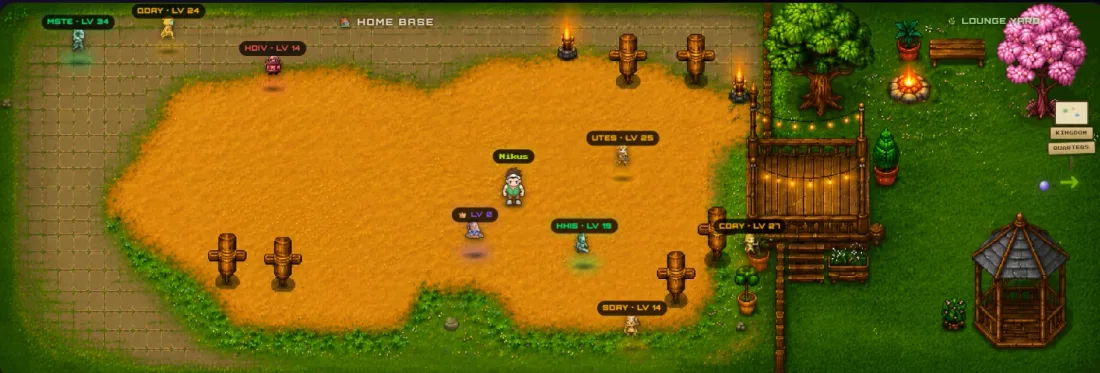
That is the entire premise IncomeRPG is built on. Your real holdings become characters. Their progression runs on your real distributions and your real contributions, so the game advances exactly when the portfolio does and never otherwise. The rewards are cosmetic by strict rule: nothing you win alters a single figure in your portfolio, and the app is read-only, so it cannot buy or sell anything on your behalf.
The point is not to make investing exciting. It is to make the first three years survivable, because the first three years are where almost everyone quits.
What we are actually trying to do
Our measure of success is narrow and we would rather state it plainly than dress it up: if someone starts investing at twenty-three instead of thirty-three because a tracker gave them a reason to keep looking, the app has done its job. Everything else — the tools, the cards, the village, the ranks — exists to serve that one outcome.
It is worth being equally plain about what this is not. IncomeRPG does not tell anyone what to buy. It does not rank funds by what it earns, because it earns nothing from them. It cannot move money. It is a tracker with a reason to open it, and the decisions stay entirely yours.
Questions people also ask
Why don't young people invest?
Mostly for non-financial reasons: the payoff is decades away and the brain discounts distant rewards steeply, a first deposit produces no visible change, losses feel roughly twice as strong as equivalent gains, and the activity is usually presented as a spreadsheet. Affordability is rarely the real block.
What age should you start investing?
Earlier compounds longer — that is arithmetic rather than advice. The practical question is not what age is optimal but what makes someone keep going once they have started, because stopping after a year undoes most of the advantage of starting early.
Does gamifying investing actually help people start?
It depends what is rewarded. Rewarding trades encourages trading, which is the version worth being sceptical of. Rewarding contributing, holding and reinvesting attaches feedback to behaviour that was already sensible. IncomeRPG's progression runs only on real portfolio events and its rewards are purely cosmetic.
How much money do you need to start investing?
Less than most people assume — many brokerages allow fractional or single-share purchases. The harder threshold is not the first deposit but the tenth, which is a habit problem rather than a money problem.
Is IncomeRPG suitable for a complete beginner?
The four free tools are built to be readable with no holdings and no account — looking up a fund, comparing two, and seeing what a fund has actually paid. That is usually where beginners start.
IncomeRPG is a portfolio tracker, not an advisor. Nothing here is investment, tax or financial advice, and nothing here is a recommendation to buy or sell any security. The brokerage connection is read-only. The app cannot place a trade or move money.